
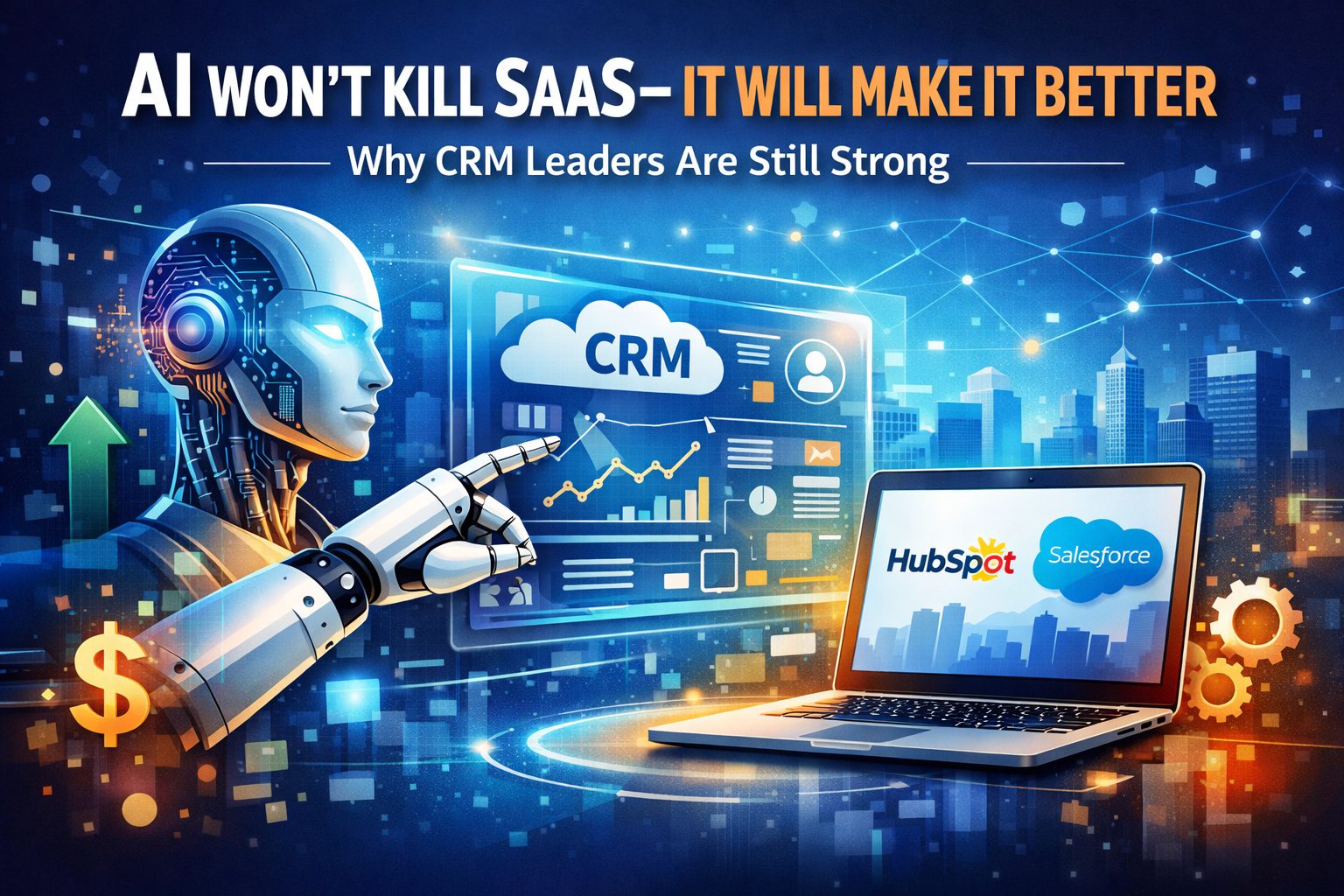
Over the past few months, major SaaS and CRM companies like Salesforce, HubSpot, and monday.com have seen meaningful stock volatility. The narrative is loud and simple:
“AI will replace SaaS.”
“Agents will kill seat-based software.”
“Traditional CRMs are obsolete.”
It’s a compelling headline.
It’s also an oversimplification.
From where we stand, AI isn’t eliminating SaaS. It’s accelerating a shift that was already underway — and separating platforms from tools.
The Market Is Repricing — Not Predicting Collapse
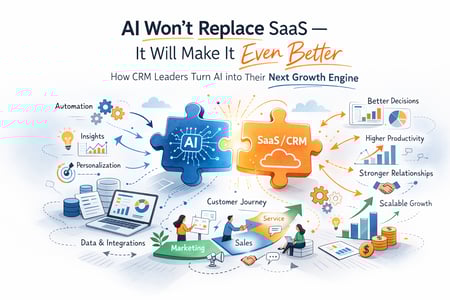 Yes, public SaaS multiples have compressed. Investors are questioning whether traditional seat-based models can hold up in an AI-agent world.
That concern isn’t irrational.
If AI can autonomously draft emails, qualify leads, summarize calls, or generate campaigns, why pay per seat?
But this assumes that SaaS companies are static products. They aren’t.
The best platforms are evolving into systems of intelligence, not just systems of record.
AI Does Not Replace Infrastructure
AI is powerful. But AI without infrastructure is chaos.
Enterprises don’t just need answers. They need:
- Structured data
- Workflow governance
- Permission controls
- Reporting accuracy
- Cross-team coordination
- Compliance tracking
- Auditability
Large language models don’t replace that.
They sit on top of it.
CRMs are deeply embedded operational systems. Sales forecasts, pipeline management, customer lifecycle tracking, revenue attribution — these are not lightweight workflows you can “prompt engineer” into existence.
The AI still needs somewhere to live.
The Real Shift: From Data Storage to Revenue Orchestration
Here’s what’s actually happening.
The old CRM model focused on storing data and tracking activity.
The next-generation model focuses on:
- Guiding reps in real time
- Automating repetitive execution
- Predicting next-best actions
- Surfacing revenue risk early
- Orchestrating marketing, sales, and service as one system
This is where companies like HubSpot have moved aggressively.
HubSpot wasn’t built as a legacy enterprise system retrofitting AI. It was built around inbound growth, product-led adoption, and iteration speed. Embedding AI into that DNA is additive, not disruptive.
AI features like content generation, lead scoring, automation builders, and predictive insights don’t replace HubSpot’s core value — they enhance it.
The same logic applies to Salesforce. Its competitive advantage is ecosystem depth, integrations, and enterprise trust. AI becomes an amplifier.
The Seat-Based Fear Is Overstated
Another popular argument is that AI agents reduce the number of human “seats” required, shrinking revenue models.
Maybe — in certain workflows.
But historically, productivity gains in software haven’t reduced spend. They’ve expanded scope.
When email automation improved marketing efficiency, companies didn’t shrink marketing teams — they scaled campaigns.
When analytics tools became easier, companies didn’t eliminate analysts — they made more data-driven decisions.
AI increases output capacity. Increased output often increases demand.
The winners will be companies that shift from charging for access to charging for value creation.
HubSpot’s early moves toward outcome-driven capabilities reflect that shift.
Why CRM Leaders Are Positioned to Win
The companies most at risk are thin-feature SaaS tools that do one narrow task.
The platforms with:
- Deep data layers
- Strong ecosystem integrations
- Embedded workflows
- Established customer trust
- Fast product iteration cycles
are positioned differently.
HubSpot in particular has historically demonstrated:
- Rapid product evolution
- Strong SMB and mid-market penetration
- Tight integration between marketing, sales, and service
- Clear strategic narrative
That matters in a transition cycle.
Markets tend to overshoot during technological shifts. In the short term, uncertainty drives repricing. In the long term, infrastructure providers that adapt tend to strengthen their moat.
AI vs SaaS Is the Wrong Framing
The real competition isn’t AI vs SaaS.
It’s:
- Static software vs adaptive platforms
- Feature tools vs revenue engines
- Legacy complexity vs unified systems
AI becomes a feature of SaaS — not its replacement.
The companies that treat AI as a bolt-on widget will struggle.
The companies that redesign workflows around AI will widen their lead.
Final Perspective from Treelio
Every major software cycle has triggered “the end of software” predictions:
Cloud computing
Mobile-first
Open-source
No-code
Each time, the category didn’t disappear. It matured.
AI is the next layer of maturity.
CRM is not dying. It’s evolving from database to decision engine.
And the companies that were built with innovation in their DNA are unlikely to be casualties of this shift — they’re likely to be its architects.

 Why Treelio